Approach
Method
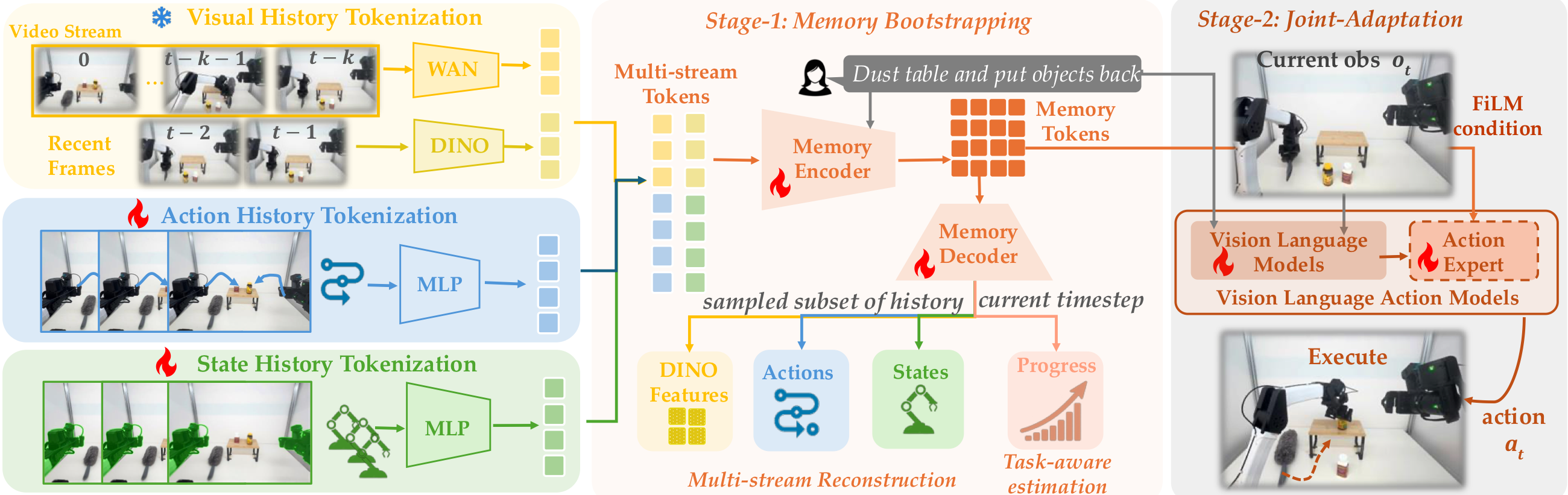
IMPRINT compresses visual, action, and proprioceptive history into a fixed-size latent memory, bootstraps that memory with reconstruction and task-progress supervision, and then jointly adapts it with a VLA for control.
Approach
IMPRINT compresses visual, action, and proprioceptive history into a fixed-size latent memory, bootstraps that memory with reconstruction and task-progress supervision, and then jointly adapts it with a VLA for control.
Experiments
We propose IMPRINT, a policy-agnostic latent memory framework that efficiently compresses multi-stream histories and trains with history reconstruction and progress estimation before joint fine-tuning with the policy.
We systematically analyze how memory capacity, encoding, training objectives, and training recipes affect downstream performance.
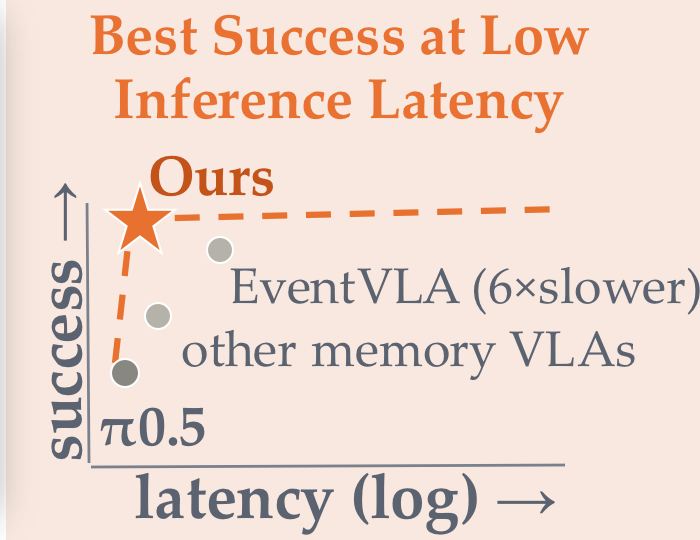
Across RMBench, a 12-task RoboCasa benchmark, and three real-world tasks, IMPRINT improves success over the base VLA by 47.4% on RMBench and 50% in the real world, while achieving the lowest average latency and highest success among the memory baselines in the latency comparison.
Evaluation
Select a task, compare the reported result, and browse every associated rollout. Green and red labels indicate success and failure under the paper's evaluation criteria.
The robot must place the objects down upright, dust the table exactly once, and return the objects upright to the small table in the correct left/right arrangement.
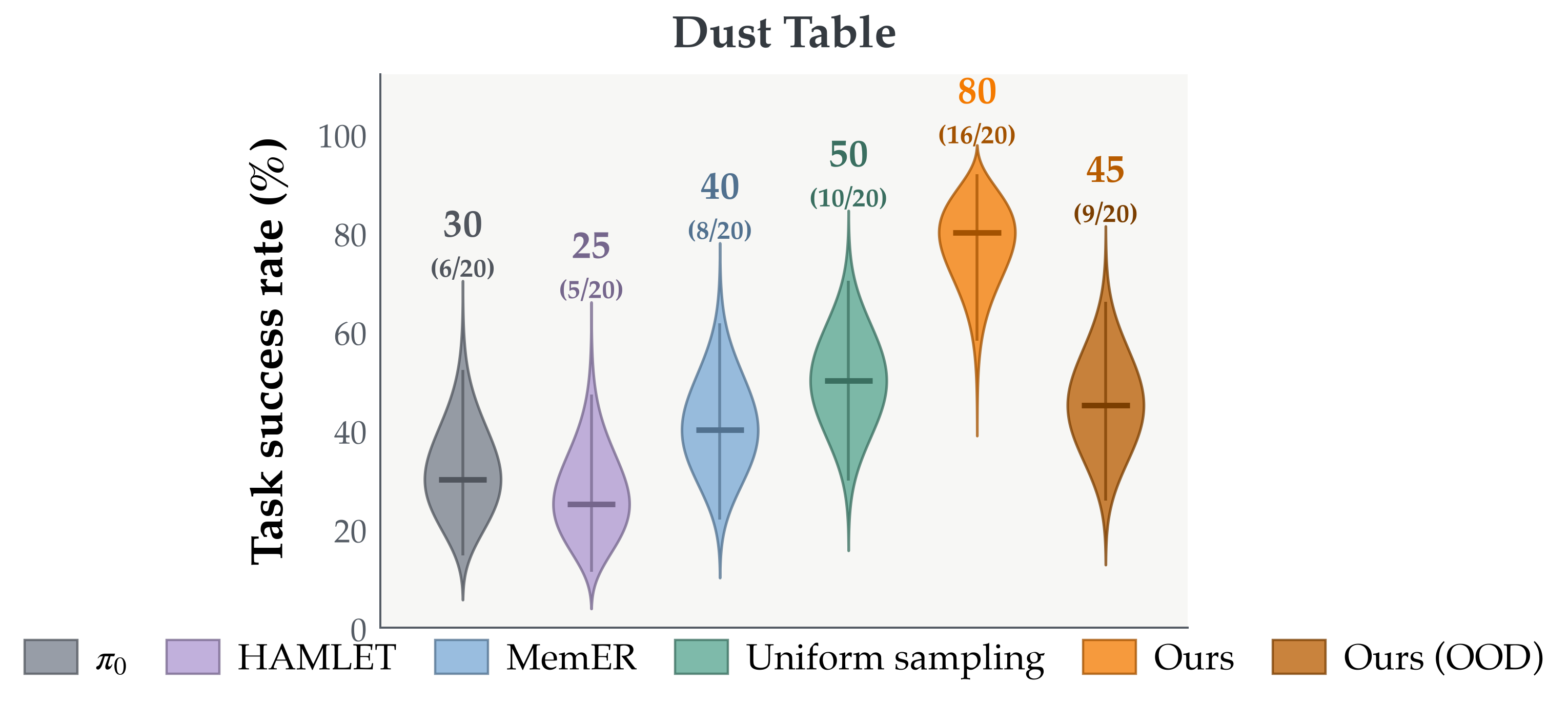
Reported task result
Result analysis IMPRINT reaches 80%, 30 points above uniform sampling; the unseen-object setting reaches 45%.
| Method | Success (%) | Successes / trials |
|---|
In-context example
Automatically matched to the selected rollout’s towel color and folding style.
Method
16 / 20 successful
Associated trials
Success Failure
Representative example
Retained keyframe bank
Each checkpoint shows the recorded memory state and accepted subtask prediction from one representative episode.
Evaluation
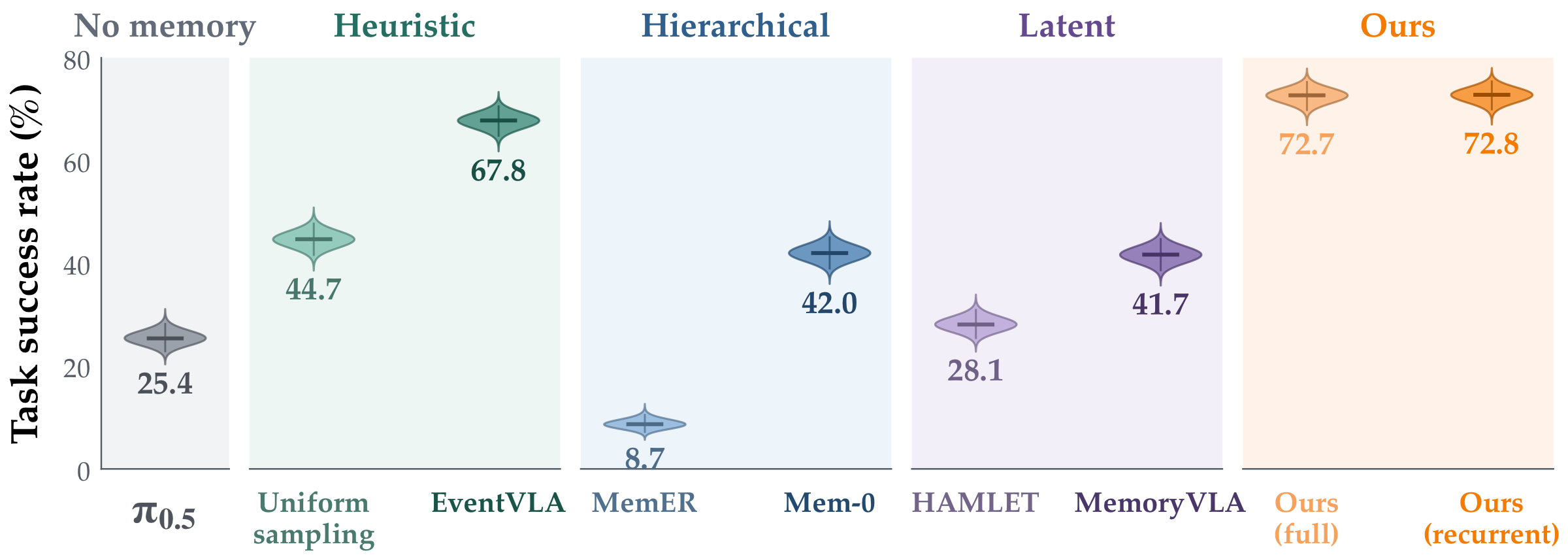
Per-task and average success on the nine memory-dependent tasks in RMBench.
| Method | Obs. / Pick | Rearrange | Put Back | Swap Blocks | Swap T | Battery | Ranking | Cover | Press | Average |
|---|---|---|---|---|---|---|---|---|---|---|
| π0.5 | 8 | 63 | 20 | 16 | 8 | 30 | 66 | 15 | 3 | 25.4 |
| Uniform sampling | 5 | 79 | 100 | 62 | 30 | 28 | 82 | 13 | 3 | 44.7 |
| EventVLA | 21 | 96 | 95 | 96 | 87 | 35 | 81 | 97 | 3 | 67.8 |
| MemER | 7 | 17 | 0 | 14 | 7 | 27 | 0 | 6 | 0 | 8.7 |
| Mem-0 | 4 | 89 | 90 | 67 | 14 | 28 | 18 | 68 | 0 | 42.0 |
| HAMLET | 6 | 76 | 23 | 25 | 13 | 26 | 70 | 14 | 0 | 28.1 |
| MemoryVLA | 2 | 53 | 81 | 76 | 9 | 33 | 53 | 69 | 0 | 41.7 |
| Ours (full) | 9 | 100 | 100 | 100 | 100 | 41 | 83 | 100 | 21 | 72.7 |
| Ours (recurrent) | 6 | 99 | 100 | 100 | 100 | 35 | 84 | 100 | 31 | 72.8 |
Result analysis Recurrent IMPRINT leads the strongest baseline by 5.0 points and reaches 99–100% on five tasks; remaining errors cluster in Observe / Pick, Battery, and Press Button.
Evaluation rollouts
Choose a task and drag the method bar to compare logged evaluations.
Pick the object matching a target shown before occlusion.
One valid logged camera mosaic is shown for each available outcome. Aggregate rates are computed from all 100 evaluation trials.
Evaluation
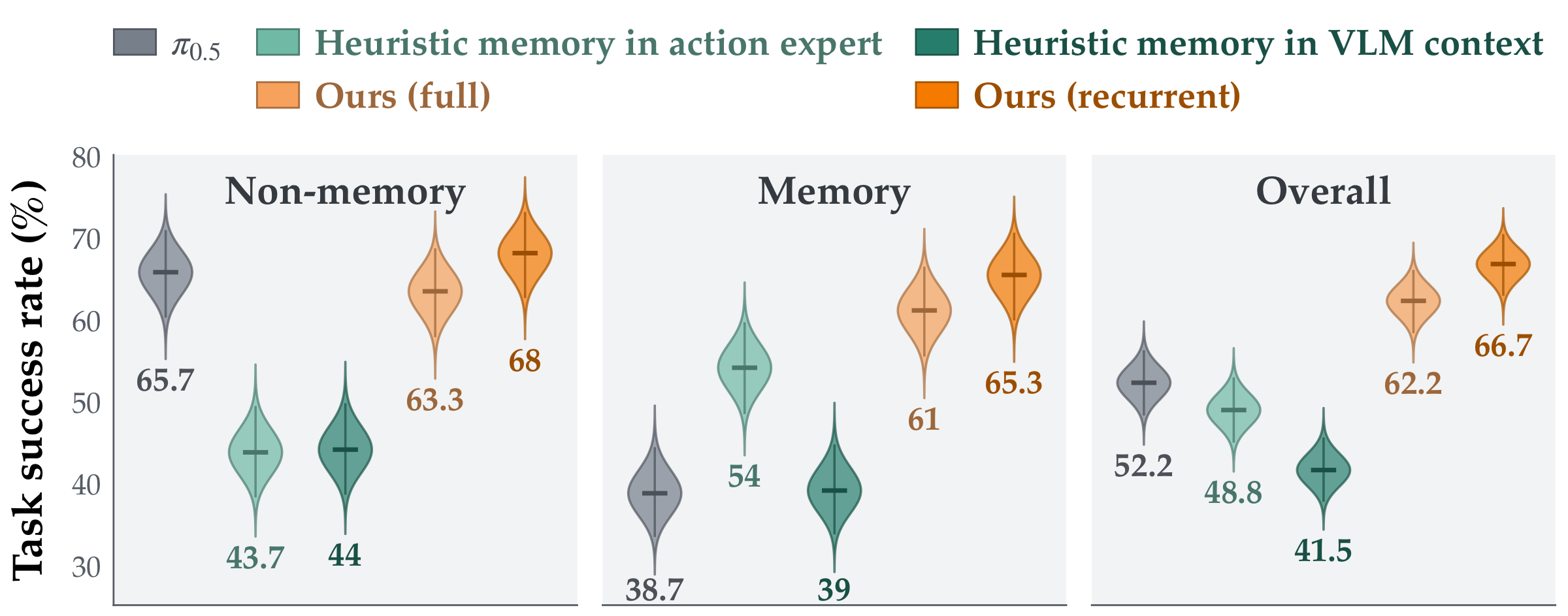
Average success on memory-dependent and memory-free task groups in RoboCasa.
| Task | Type | π0.5 | Heuristic action expert | Heuristic VLM context | Ours (full) | Ours (recurrent) |
|---|---|---|---|---|---|---|
| Retrieve fruit | Memory | 42 | 88 | 60 | 84 | 90 |
| Retrieve oil | Memory | 48 | 98 | 50 | 76 | 80 |
| Wash and return left/right | Memory | 46 | 58 | 46 | 86 | 96 |
| Wash and return same location | Memory | 46 | 36 | 44 | 62 | 58 |
| Rinse cutting board | Memory | 4 | 8 | 0 | 0 | 4 |
| Sweeten hot chocolate | Memory | 46 | 36 | 34 | 58 | 64 |
| Pan transfer | Non-memory | 74 | 48 | 44 | 76 | 72 |
| Frying pan adjustment | Non-memory | 76 | 52 | 22 | 72 | 70 |
| Organize condiments | Non-memory | 72 | 32 | 48 | 62 | 74 |
| Place equal ice cubes | Non-memory | 16 | 6 | 6 | 6 | 20 |
| Scrub cutting board | Non-memory | 60 | 50 | 56 | 66 | 76 |
| Move from counter to sink | Non-memory | 96 | 74 | 88 | 98 | 96 |
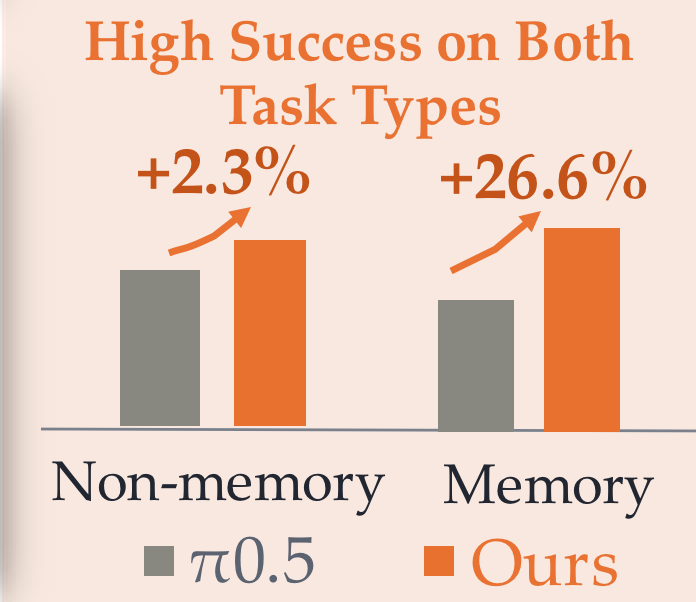
Result analysis Heuristic history helps memory tasks but hurts non-memory tasks. Recurrent IMPRINT improves both, suggesting its latent memory is used only when needed.
Full evaluation archive
12 tasks · 5 methods · 50 rollouts · 3 synchronized camera views
Place the {fruit} in the sink; recall which side of the sink it was observed on.
Memory task
Mem Fruit In Sink Left Far · episode 000
Associated rollouts
Success Failure
The three views are synchronized and show the same rollout. Success and failure labels follow the supplied archive manifest.
Evaluation
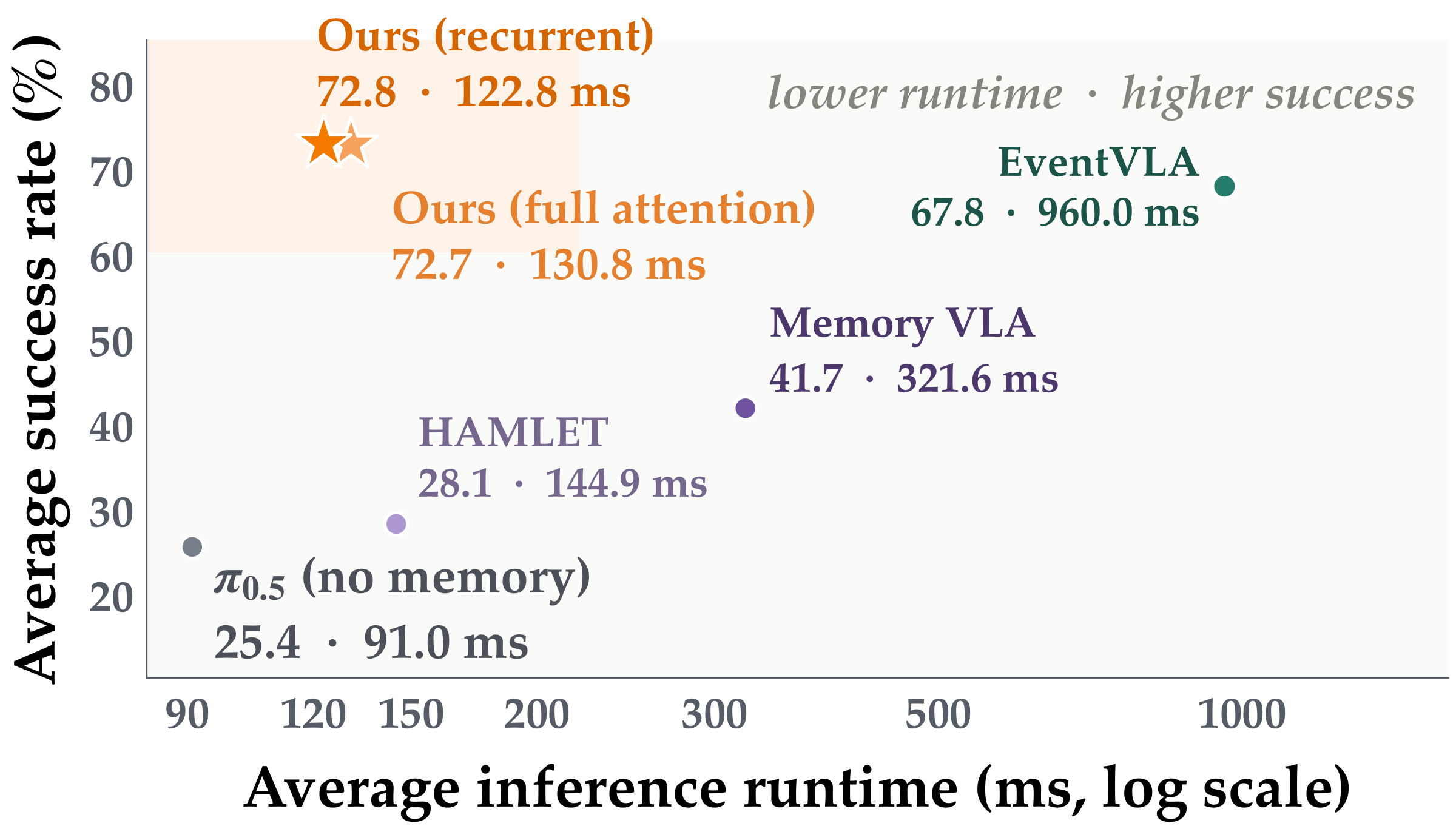
Average RMBench success versus inference latency per action chunk.
| Method | Success (%) | Runtime (ms) |
|---|---|---|
| π0.5 (no memory) | 25.4 | 91.0 |
| HAMLET | 28.1 | 144.9 |
| MemoryVLA (QwenOFT) | 41.7 | 321.6 |
| EventVLA | 67.8 | 960.0 |
| Ours (full attention) | 72.7 | 130.8 |
| Ours (recurrent) | 72.8 | 122.8 |
Result analysis Recurrent IMPRINT achieves the best success–latency tradeoff: 72.8% success at 122.8 ms, only 31.8 ms slower than the no-memory policy and faster than full attention.
Ablations & analysis
Memory bottleneck capacity and full-attention versus recurrent encoding.
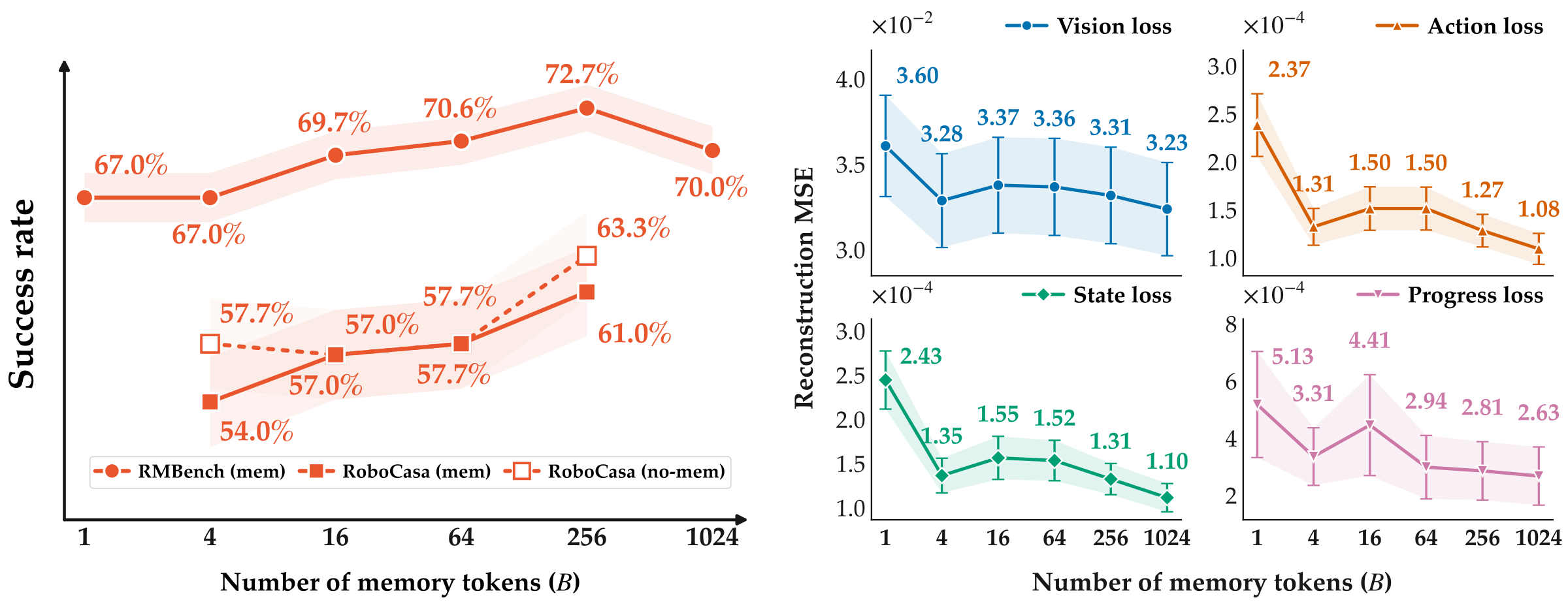
| Task | Benchmark | Type | 1 token | 4 tokens | 16 tokens | 64 tokens | 256 tokens | 1024 tokens |
|---|---|---|---|---|---|---|---|---|
| Obs. / Pick | RMBench | Memory | 7 | 8 | 8 | 8 | 9 | 10 |
| Rearrange | RMBench | Memory | 100 | 100 | 100 | 100 | 100 | 99 |
| Put Back | RMBench | Memory | 100 | 100 | 100 | 100 | 100 | 100 |
| Swap Blocks | RMBench | Memory | 97 | 97 | 99 | 99 | 100 | 93 |
| Swap T | RMBench | Memory | 99 | 99 | 99 | 99 | 100 | 99 |
| Battery | RMBench | Memory | 33 | 40 | 44 | 39 | 41 | 46 |
| Ranking | RMBench | Memory | 64 | 73 | 79 | 81 | 83 | 68 |
| Cover | RMBench | Memory | 74 | 68 | 83 | 83 | 100 | 100 |
| Press | RMBench | Memory | 29 | 18 | 15 | 26 | 21 | 15 |
| RMBench average | RMBench | Memory | 67.0 | 67.0 | 69.7 | 70.6 | 72.7 | 70.0 |
| Retrieve fruit | RoboCasa | Memory | — | 80 | 74 | 80 | 84 | — |
| Retrieve oil | RoboCasa | Memory | — | 66 | 78 | 70 | 76 | — |
| Wash and return | RoboCasa | Memory | — | 92 | 84 | 82 | 86 | — |
| Wash and return same location | RoboCasa | Memory | — | 46 | 62 | 60 | 62 | — |
| Rinse cutting board | RoboCasa | Memory | — | 0 | 0 | 0 | 0 | — |
| Sweeten hot chocolate | RoboCasa | Memory | — | 40 | 44 | 54 | 58 | — |
| RoboCasa memory average | RoboCasa | Memory | — | 54.0 | 57.0 | 57.7 | 61.0 | — |
| Pan transfer | RoboCasa | Non-memory | — | 78 | 68 | 70 | 76 | — |
| Frying pan adjustment | RoboCasa | Non-memory | — | 58 | 58 | 58 | 72 | — |
| Organize condiments | RoboCasa | Non-memory | — | 48 | 52 | 60 | 62 | — |
| Place equal ice cubes | RoboCasa | Non-memory | — | 4 | 10 | 6 | 6 | — |
| Scrub cutting board | RoboCasa | Non-memory | — | 60 | 60 | 56 | 66 | — |
| Counter to sink | RoboCasa | Non-memory | — | 98 | 94 | 96 | 98 | — |
| RoboCasa non-memory average | RoboCasa | Non-memory | — | 57.7 | 57.0 | 57.7 | 63.3 | — |
| Tokens | Total ×10−2 | Vision ×10−2 | Action ×10−4 | State ×10−4 | Progress ×10−4 |
|---|---|---|---|---|---|
| 1 | 3.649 ± 0.295 | 3.599 | 2.37 | 2.43 | 5.13 |
| 4 | 3.308 ± 0.273 | 3.278 | 1.31 | 1.35 | 3.31 |
| 16 | 3.406 ± 0.277 | 3.368 | 1.50 | 1.55 | 4.41 |
| 64 | 3.389 ± 0.282 | 3.359 | 1.50 | 1.52 | 2.94 |
| 256 | 3.338 ± 0.280 | 3.311 | 1.27 | 1.31 | 2.81 |
| 1024 | 3.256 ± 0.270 | 3.232 | 1.08 | 1.10 | 2.63 |
Result analysis Success rises from 67.0% with one token to 72.7% with 256. At 1024 tokens, reconstruction loss improves but success falls to 70.0%, so lower loss does not guarantee better control.

| Task | Benchmark | Full attention | Recurrent |
|---|---|---|---|
| Obs. / Pick | RMBench | 9 | 6 |
| Rearrange | RMBench | 100 | 99 |
| Put Back | RMBench | 100 | 100 |
| Swap Blocks | RMBench | 100 | 100 |
| Swap T | RMBench | 100 | 100 |
| Battery | RMBench | 41 | 35 |
| Ranking | RMBench | 83 | 84 |
| Cover | RMBench | 100 | 100 |
| Press | RMBench | 21 | 31 |
| Retrieve fruit | RoboCasa | 84 | 90 |
| Retrieve oil | RoboCasa | 76 | 80 |
| Wash and return left/right | RoboCasa | 86 | 96 |
| Wash and return same location | RoboCasa | 62 | 58 |
| Rinse cutting board | RoboCasa | 0 | 4 |
| Sweeten hot chocolate | RoboCasa | 58 | 64 |
| Pan transfer | RoboCasa | 76 | 72 |
| Frying pan adjustment | RoboCasa | 72 | 70 |
| Organize condiments | RoboCasa | 62 | 74 |
| Place equal ice cubes | RoboCasa | 6 | 20 |
| Scrub cutting board | RoboCasa | 66 | 76 |
| Move from counter to sink | RoboCasa | 98 | 96 |
| RMBench average | RMBench | 72.7 | 72.8 |
| RoboCasa memory average | RoboCasa | 61.0 | 65.3 |
| RoboCasa non-memory average | RoboCasa | 63.3 | 68.0 |
| RoboCasa overall average | RoboCasa | 62.2 | 66.7 |
Result analysis Recurrent and full attention tie on RMBench. Recurrence raises RoboCasa success from 62.2% to 66.7% while reducing latency from 130.8 to 122.8 ms.
Ablations & analysis
Cover Blocks analysis using the unsupervised 50–100% history projection and stream attention at step 750.

| Training | t-SNE silhouette S | Linear probe (%) | Task success (%) |
|---|---|---|---|
| E2E | −0.08 | 19.9 | 15 |
| Frozen bootstrapped memory | +0.23 | 83.3 | 35 |
| Ours (finetuned) | +0.36 | 91.5 | 100 |
Result analysis Across end-to-end, frozen, and jointly adapted memory, probe accuracy rises 19.9% → 83.3% → 91.5% and task success 15% → 35% → 100%, linking structured memory to better control.
Interactive attention trace
Select a training method and drag the episode timebar.

Current-observation panels show the policy inputs at the selected action step. Highest-attention panels show the top historical item within each stream, with w reporting its attention weight. Action and robot-state selections are visualized using the head-camera frame aligned to the selected timestep.
Ablations & analysis
Training-recipe ablations and results across three VLA backbones.

| Task | E2E | Ours (frozen) | Ours |
|---|---|---|---|
| Obs. / Pick | 12 | 7 | 9 |
| Rearrange | 90 | 99 | 100 |
| Put Back | 100 | 100 | 100 |
| Swap Blocks | 90 | 99 | 100 |
| Swap T | 45 | 99 | 100 |
| Battery | 27 | 20 | 41 |
| Ranking | 73 | 68 | 83 |
| Cover | 15 | 35 | 100 |
| Press | 5 | 2 | 21 |
| Average | 50.8 | 58.8 | 72.7 |
Result analysis Supervising memory to retain multiple streams and estimate progress raises average success from 50.8% to 58.8%; joint memory–policy adaptation reaches 72.7%.
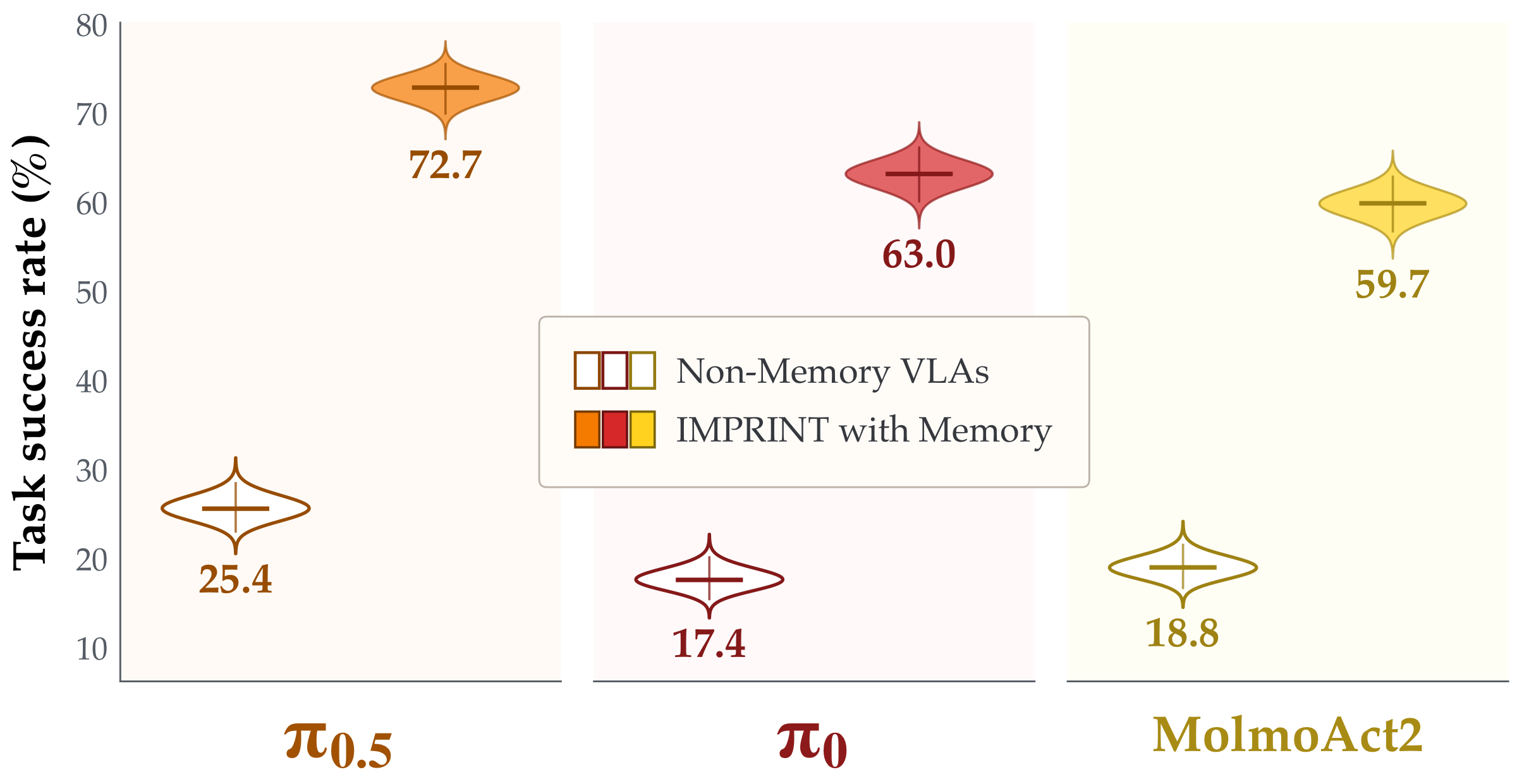
| Task | π0.5: No memory | π0.5: With memory | π0: No memory | π0: With memory | MolmoAct2: No memory | MolmoAct2: With memory |
|---|---|---|---|---|---|---|
| Obs. / Pick | 8 | 9 | 8 | 6 | 4 | 4 |
| Rearrange | 63 | 100 | 13 | 99 | 52 | 100 |
| Put Back | 20 | 100 | 49 | 100 | 0 | 100 |
| Swap Blocks | 16 | 100 | 4 | 100 | 11 | 65 |
| Swap T | 8 | 100 | 0 | 98 | 15 | 100 |
| Battery | 30 | 41 | 27 | 30 | 7 | 5 |
| Ranking | 66 | 83 | 54 | 56 | 62 | 74 |
| Cover | 15 | 100 | 0 | 78 | 18 | 83 |
| Press | 3 | 21 | 2 | 0 | 0 | 6 |
| Average | 25.4 | 72.7 | 17.4 | 63.0 | 18.8 | 59.7 |
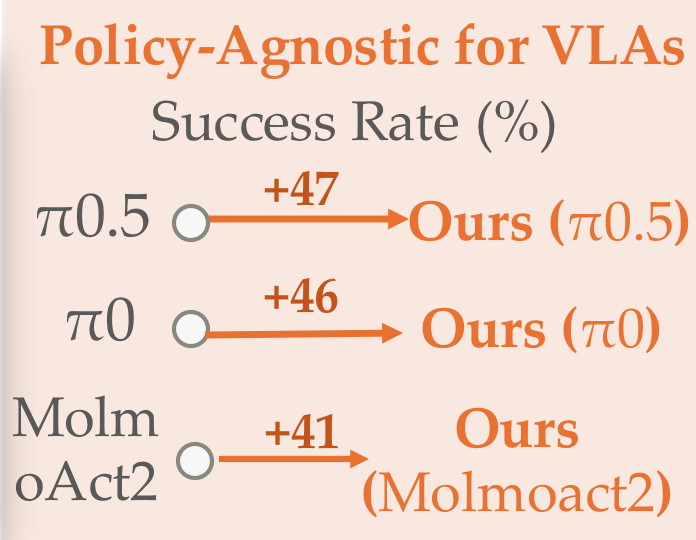
Result analysis Memory improves average success by 47.3, 45.6, and 40.9 points for π0.5, π0, and MolmoAct2, respectively, showing the approach transfers across VLA backbones.
Memory supervision ablations
Full-attention encoder with a fixed 256-token memory bottleneck.
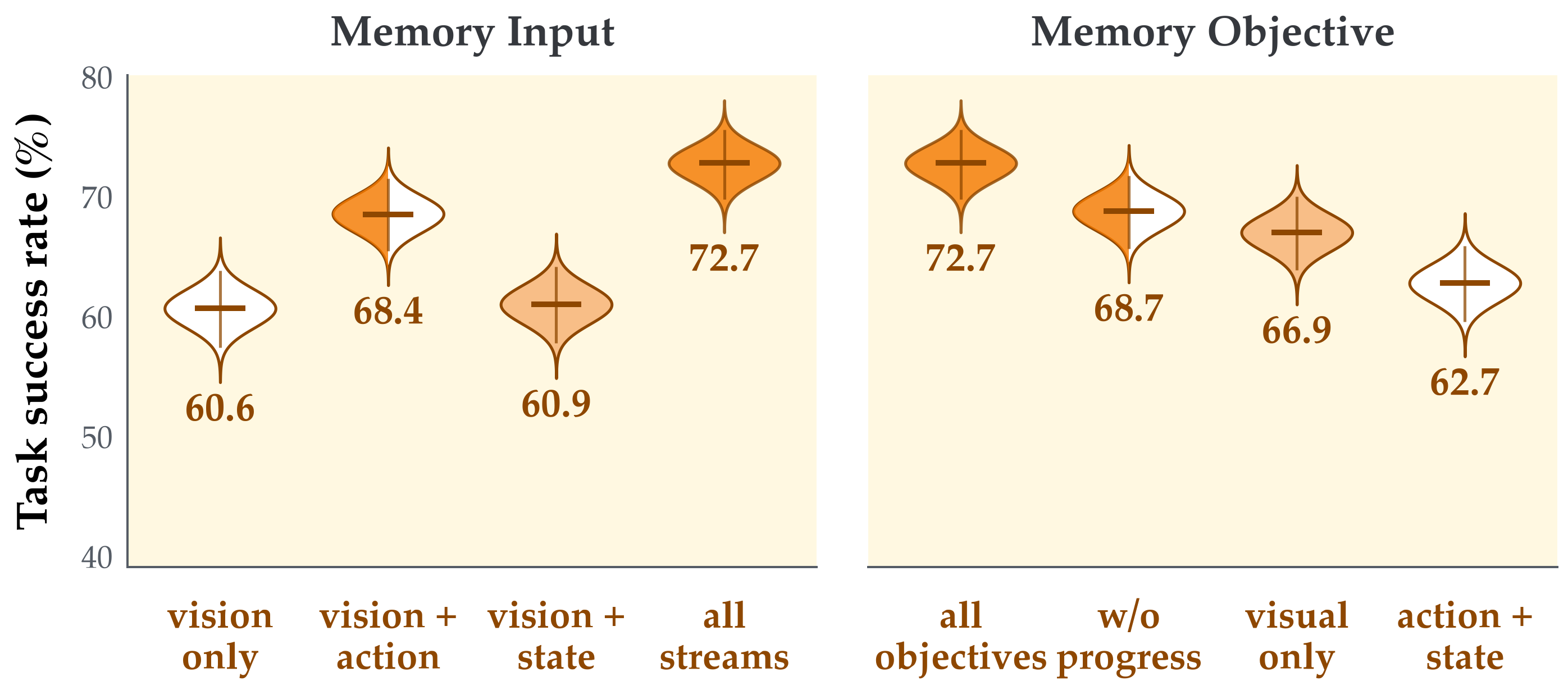
| Historical inputs | Obs. / Pick | Rearrange | Put Back | Swap Blocks | Swap T | Battery | Ranking | Cover | Press | Average |
|---|---|---|---|---|---|---|---|---|---|---|
| Vision only | 9 | 93 | 100 | 81 | 45 | 30 | 80 | 100 | 7 | 60.6 |
| Vision + Action | 6 | 100 | 100 | 100 | 99 | 38 | 72 | 83 | 18 | 68.4 |
| Vision + State | 9 | 94 | 100 | 98 | 99 | 28 | 46 | 70 | 4 | 60.9 |
| Vision + Action + State (IMPRINT) | 9 | 100 | 100 | 100 | 100 | 41 | 83 | 100 | 21 | 72.7 |
| Bootstrap objective | Obs. / Pick | Rearrange | Put Back | Swap Blocks | Swap T | Battery | Ranking | Cover | Press | Average |
|---|---|---|---|---|---|---|---|---|---|---|
| All objectives (IMPRINT) | 9 | 100 | 100 | 100 | 100 | 41 | 83 | 100 | 21 | 72.7 |
| Without progress | 6 | 91 | 100 | 90 | 97 | 35 | 73 | 100 | 26 | 68.7 |
| Visual only | 6 | 78 | 100 | 89 | 99 | 30 | 85 | 100 | 15 | 66.9 |
| Action + state | 5 | 100 | 100 | 89 | 98 | 36 | 61 | 52 | 23 | 62.7 |
Result analysis Visual-only memory loses 12.1 points, and visual-only reconstruction loses 5.8 points. Combining visual, action, and state histories with reconstruction and progress supervision performs best at 72.7%.